



The Math of One
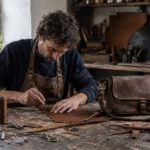
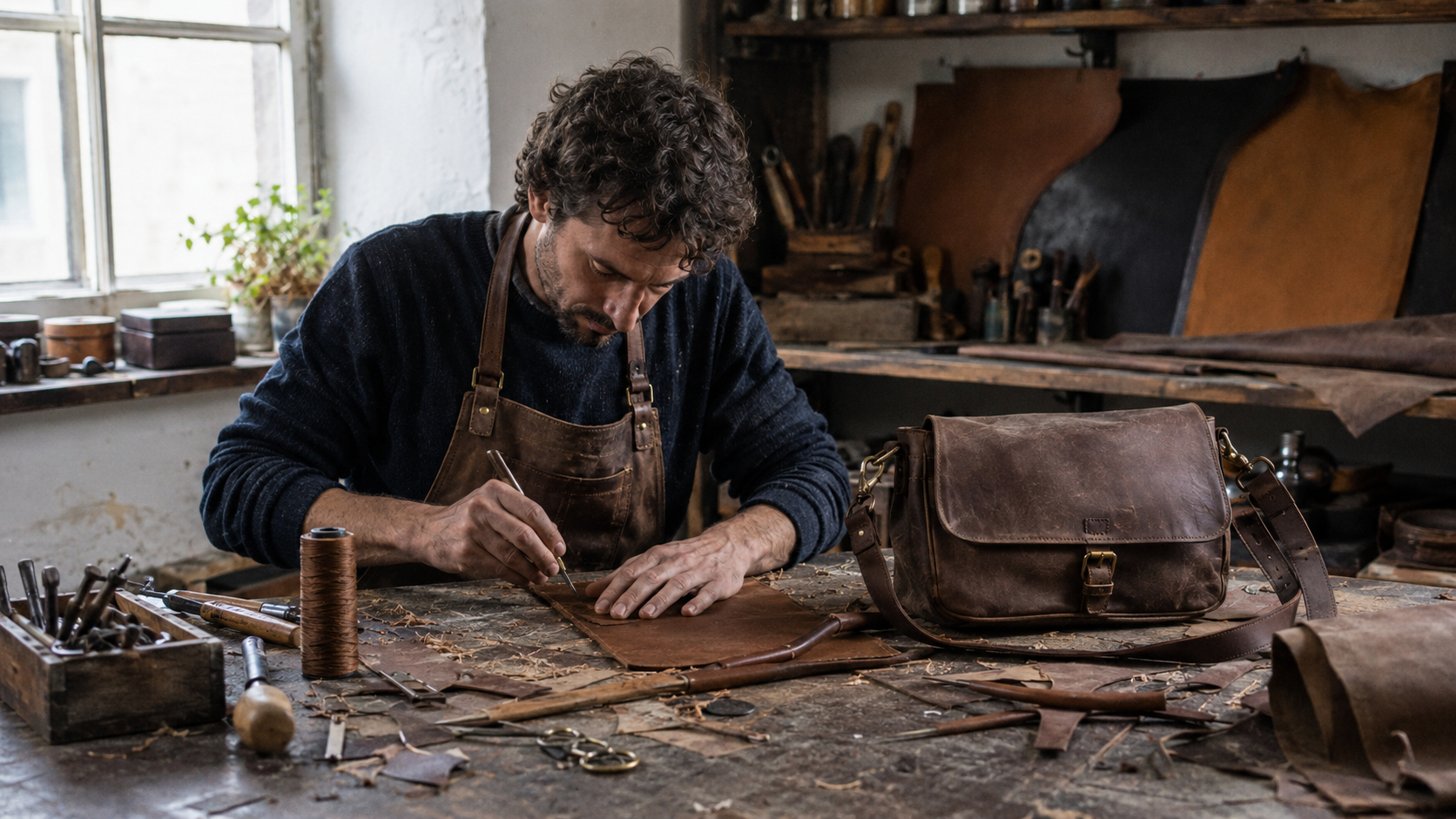
Everett stitches with an awl in his right hand and a needle in each direction of a single thread, and by the time a bag leaves his bench it has been through his hands for something close to eighteen hours. Not eighteen hours of watching machines run. Eighteen hours of him, physically, doing the work. He knows this number the way a pilot knows fuel burn. It is not a marketing figure. It is a ceiling.
Ask him how many bags he could make in a year if demand were unlimited and he does a small calculation out loud, dividing weeks by hours, arriving at a number that sounds almost apologetic. Somewhere around fifty. That is the whole business. Fifty bags, made by one person, in a converted garage bay outside Lancaster with good north light and a bench that used to belong to someone else’s grandfather.
This is the part most people misunderstand about small batch leather work. They assume the limitation is intentional scarcity, a lever pulled to make the product feel more desirable. It is not. The limitation is anatomical. A hand can only pull a waxed thread so many times before it needs to rest, and a mind can only hold the tension of a clean line for so many hours before the work starts to drift. Everett has tried to compress the timeline before, years ago, when a boutique in Philadelphia wanted a dozen units by a date that math simply would not allow. He said no. He still thinks about the money he turned down that month, and he still thinks it was the right call.
Choosing What Won’t Photograph Well
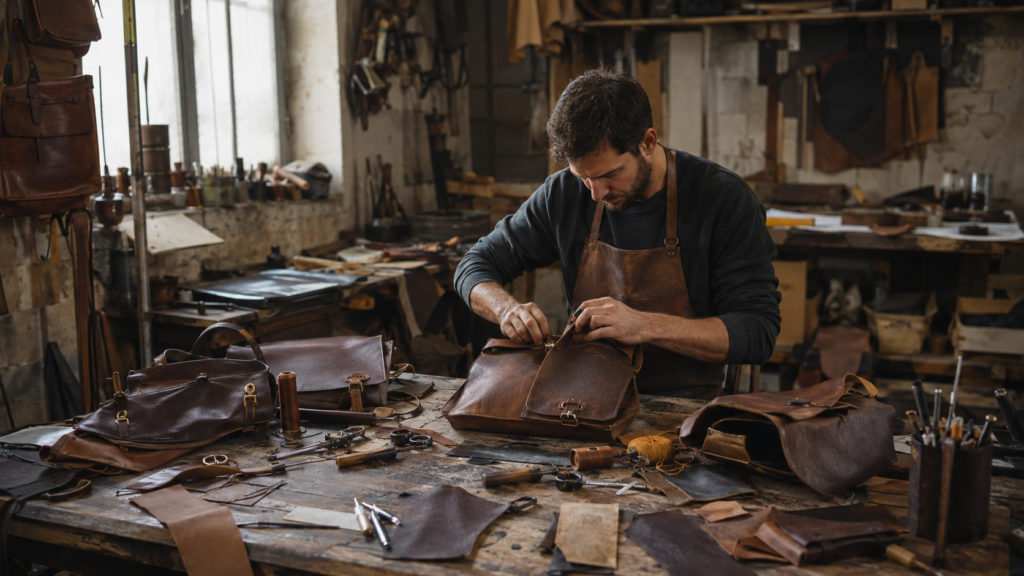
The hide arrives in a roll, and before anything else happens, most of it gets rejected. Not because it looks bad. Some of the most photogenic leather on the market is the leather Everett trusts the least.
Corrected grain leather has been sanded and buffed until every natural mark is gone, then embossed with a texture to fake the imperfection it just erased. It looks flawless under a product light. It also seals the surface with a finish that will crack rather than soften, because the very fibers that would have aged into character have been sanded away. Full grain leather, the kind Everett buys, comes with scars still in it. Insect bites healed over on the animal’s back, a faint branding mark, a wrinkle where the hide bent around a shoulder. None of it sells well in a thumbnail. All of it is the reason the leather will still be flexible and honest in fifteen years.
He runs his palm across a new hide the way someone might read a page of braille, feeling for the parts that are too thin, too stretched, too close to a scar that will widen under stress. A stitching line placed an inch to the left of where he intends it can sit directly over a weak spot in the hide and no customer will ever notice until the bag is three years old and starting to give way at a seam that should have held.
He isn’t choosing leather for how it looks today. He’s choosing it for an argument he won’t be present to win, ten years from now, when someone asks why their bag still closes the way it did on day one.
The Stitching Is the Argument
Everett does not own a sewing machine capable of leather work, and this is a choice, not an inheritance. A machine drives a single continuous thread through both layers in a lockstitch, which is fast and strong until the moment it isn’t. Cut or fray one thread anywhere along that line and the whole seam can unravel from that point, the way a run travels up a stocking.
Saddle stitching solves a problem the machine was never built to solve. Two needles, two threads, each one crossing through the same hole from opposite directions, locking against each other inside the leather rather than on top of it. If one thread fails, the other is still there, still holding, still doing the job it was cut for. It is slower by a factor most people would find absurd. It is also, structurally, a different kind of promise.
This is where the profile could easily slide into romance, the artisan bent over his bench in a shaft of golden light, but Everett resists that version of himself almost on instinct. He talks about stitch density in stitches per inch the way an engineer talks about tolerances, and he corrects himself mid sentence when a description sounds too poetic. What he is doing, in his own words, is distributing risk across redundant points so that failure, when it eventually comes, comes slowly and visibly instead of all at once.
A machine stitch fails all at once. A hand stitch fails one thread at a time, which is the entire point.
The Cost of Saying No
There is a waiting list, and it moves at the speed of one person’s hands, which means the wait right now sits close to five months. Some customers understand this immediately. Others do not, and Everett has learned to recognize the difference in the first email. The ones who ask if there’s a way to expedite for an extra fee are politely told no, because there isn’t a version of the process that gets faster with more money attached to it. The bag doesn’t get faster because someone wants it faster.
He has been approached more than once by people offering to help him scale, hire out the cutting, bring on an apprentice to handle the simpler seams while he finishes the difficult ones. Each time the arithmetic has looked appealing on paper and felt wrong in practice. The moment someone else’s hands are inside the process, the eighteen hours stop being a single continuous line of judgment and become a supervised handoff, and Everett is not convinced the difference is invisible in the final object, even if it would be invisible in a photograph.
This refusal costs him real money every year. He is specific about that when asked, unbothered by the admission. What he will not do is describe it as a sacrifice, because a sacrifice implies he wanted the other outcome and gave it up. He didn’t want it. He wanted this.
What the Bag Remembers
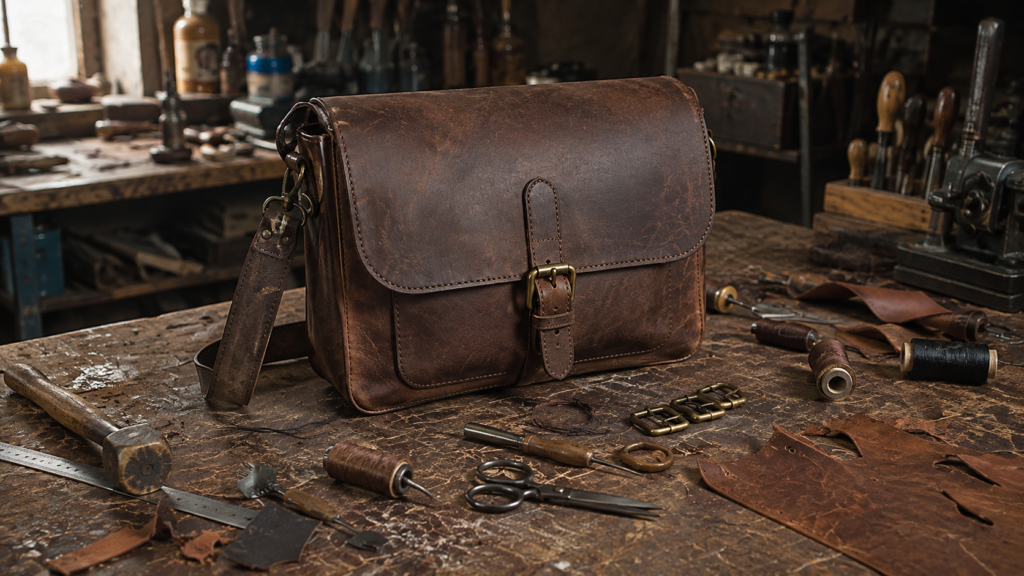
The last stage of any commission is the part that cannot be rushed by definition, because it has not happened yet. Patina is not something Everett applies. It is something that will occur later, entirely outside his control, as oil from a hand and friction from a hundred ordinary Tuesdays slowly darken the leather in exactly the pattern of how it was actually used. The strap will darken faster where a shoulder rubs it. The corners will soften faster than the flat panels. Every bag he has ever made is, in a sense, unfinished when it leaves his hands, waiting for a life to complete it.
He does not tell customers this in a sentimental way. He tells them plainly, almost like a technical disclaimer, because he wants them to expect the color to change and not mistake it for damage. What he is really describing, without quite naming it, is the difference between an object that wears out and an object that wears in. One degrades. The other accumulates evidence.
Fifty bags a year, each one carrying eighteen hours of a single person’s full attention, each one destined to spend the next decade quietly recording a life that has nothing to do with him. He will not see most of what happens to them. He has made his peace with that, the same way he has made his peace with the waiting list, the lost money, and the customers who never write back once they understand the timeline. The work does not need him to witness its second life. It only needed him to be honest during its first one.
The Paddock | Vitesse