



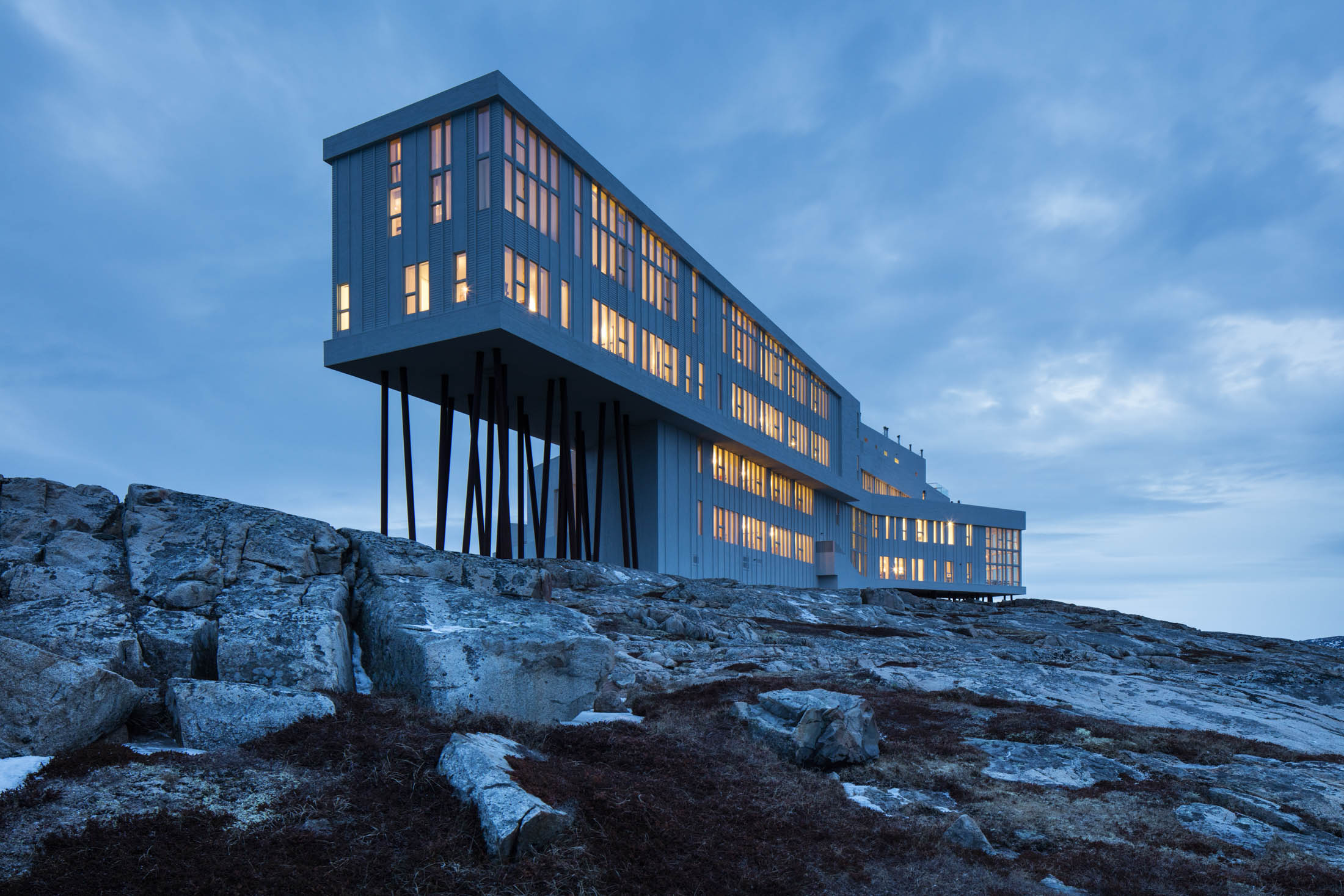
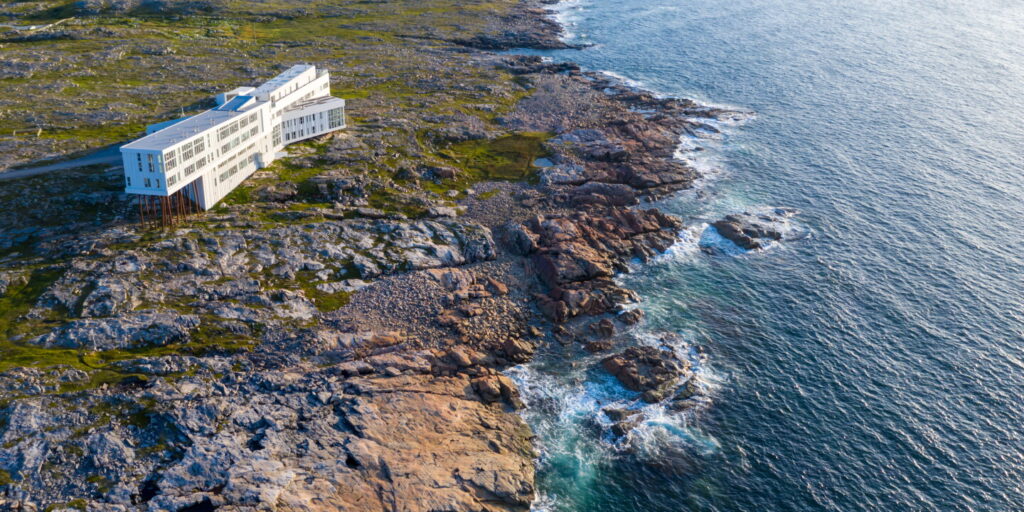
Twenty-two steel stilts hold Fogo Island Inn above the rock instead of into it. From the water, the building looks like it arrived mid stride, caught somewhere between landing and lifting off. There is no poured foundation beneath it, no basement, no slab sunk into the coastline the way a building of its size and ambition would normally demand. The inn simply rests on legs, and those legs rest on bedrock that has not been blasted, leveled, or otherwise persuaded to accommodate the structure sitting on top of it.
This was not an aesthetic flourish added after the fact. It was the first real decision made about the building, and for a long time it was the decision that made the project look like it might not survive contact with reality. A hospitality development on a remote island off the northeast coast of Newfoundland, competing for the kind of traveler who expects effortless luxury, chose a foundation system that cost more, took longer, and photographed, at least in early renderings, like an engineering compromise rather than a design statement.
A Foundation That Isn’t One
Architect Todd Saunders designed the inn for Zita Cobb’s Shorefast Foundation, and the stilted structure was there from the earliest concepts, not introduced later to solve a problem. The building needed to sit on uneven, rocky shoreline without disturbing it, and the standard solution, cutting into the rock to create a level base, was rejected almost immediately. Instead the inn is elevated on steel piers that meet the ground at irregular points, following the contour of the rock rather than correcting it.
The result is a building that never quite settles. Walk the shoreline beneath it and you can see daylight between the legs, water pooling under sections of the structure at high tide, the rock formations continuing uninterrupted where a conventional foundation would have required them to stop. The inn does not sit on Fogo Island so much as it hovers just above an argument about how a place should be touched.
That argument was expensive to win. Elevating a building of this scale on individually engineered steel piers costs more than pouring a standard foundation, and it costs more again when every pier has to be calibrated to a different point on an irregular rock surface. Nobody involved in financing the project was under the impression this was the economical choice.
The Stages That Came Before
The logic behind the stilts did not originate with luxury hospitality at all. It came from the fishing stages that once lined this coastline, wooden platforms built on stilts over water and rock so that fishermen could process their catch without needing flat, buildable land. Newfoundland’s shoreline rarely offers flat, buildable land. Fishing communities solved that problem centuries ago by building above the terrain instead of altering it, and those stages, weathered and functional, are still visible in fragments around the island.
Saunders drew on that vocabulary directly, and the choice reads as continuity rather than reference. A stage was never built to impress anyone. It was built because the alternative, cutting a flat foundation into rock along a coast this exposed, made no practical sense for people who needed to be near the water more than they needed solid ground beneath them. The inn inherits that same reasoning, applied to a different kind of work.
Every stilt is a small refusal, repeated twenty two times, to let convenience decide how the building would meet the ground.
What makes the borrowing convincing rather than decorative is that it was never treated as a style choice. The stages solved a real constraint. The inn’s stilts solve the same one, which is why the building does not read as a costume made to look local. It reads as a structure that faced the same coastline the fishing stages faced and arrived at the same answer.
What Restraint Cost
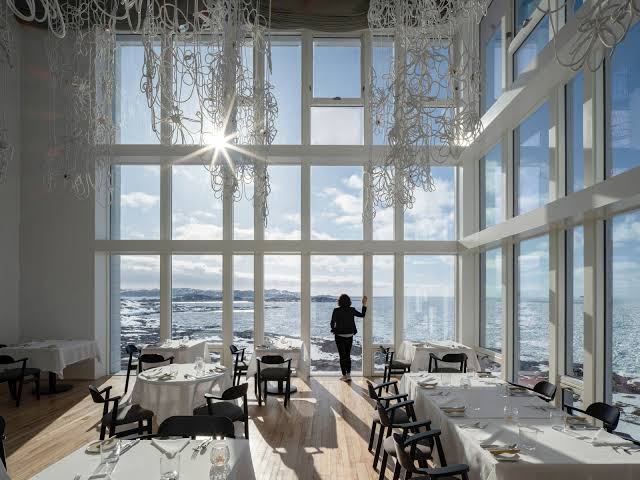
The stilted foundation was the first constraint, but it was not the only one, and the decisions that followed carried the same logic through to the guest experience. Fogo Island Inn has twenty nine rooms. It has no spa in the conventional sense, no pool, none of the amenity architecture that competing luxury properties in comparable price brackets typically build around. Furniture inside the inn is made locally, much of it by island craftspeople working from the same materials palette as the building itself.
None of this was inevitability. A property with this level of ambition and this price point could easily have added a pool, could easily have expanded past twenty nine rooms to improve the economics, could easily have imported furnishings rather than commissioning them locally at greater cost and longer lead times. Every one of those additions would have made the project easier to finance and faster to build. Each was declined in favor of a smaller, slower, more expensive version of the same idea.
The pattern holds because the first decision set the terms for every decision after it. A building willing to spend more money and construction time protecting a rock formation was never going to be the kind of building that added a pool for convenience. Restraint, once established as the operating principle, tends to keep making the same argument in every room that follows.
A Building That Argues for Itself
More than a decade after the inn opened, the stilted foundation no longer reads as a compromise. It reads as the reason the building has an identity at all. Photographs of Fogo Island Inn circulate specifically because of the elevation, the sense of a structure suspended above a landscape it declined to alter, and that image only exists because someone was willing to spend more to avoid touching the rock than they would have spent flattening it.
A building that had chosen the easier foundation would likely still be a well regarded hotel. It would not be a building people describe on sight, and it would not be the building that keeps getting cited as an example of what restraint can produce when a client refuses to trade it away for convenience. The stilts were the expensive option, the slower option, and on paper, before anyone had seen the finished building, very likely the option that looked like a mistake.
They were the decision that made everything else make sense.
The Paddock | Vitesse