




There is a particular pause that happens before a fountain pen touches paper. Not hesitation, exactly. More like a settling. The nib has to meet the surface at the right angle or it skips, and the ink needs a beat to find its way through the feed before it commits to the page. You cannot rush this part. Try to write fast and sloppy with a fountain pen the way you might dash off a note with a ballpoint, and it will either skip, blot, or drag, telling on you instantly.
That small enforced patience is the whole story, if you let it be. Everything else about the pen, the price, the ritual, the refilling, the cleaning, is downstream of this one fact: it asks something of you that cheaper, faster tools do not.
The Object That Refuses to Be Efficient
A ballpoint pen is a triumph of not thinking about it. Push the tip against paper, ink transfers by rolling contact, and the whole mechanism is built to disappear from your attention entirely. It is, by design, frictionless.
A fountain pen has opinions. Hold it wrong and the line goes thin and scratchy. Write too fast on cheap paper and the ink feathers into the fibers instead of sitting clean on top. Leave it capped for a few weeks without use and it may refuse to write at all until you coax it back with water and patience. None of this is a flaw the manufacturer never fixed. It is the mechanism working exactly as intended, and the intention was never speed.
People who have never used one assume the appeal is nostalgia, a fondness for something old because old things feel dignified. That misses what is actually happening at the point where nib meets paper. The pen is not decorative. It is demanding, in a way that a rollerball simply is not, and demand is the entire appeal.
What the Mechanism Actually Does
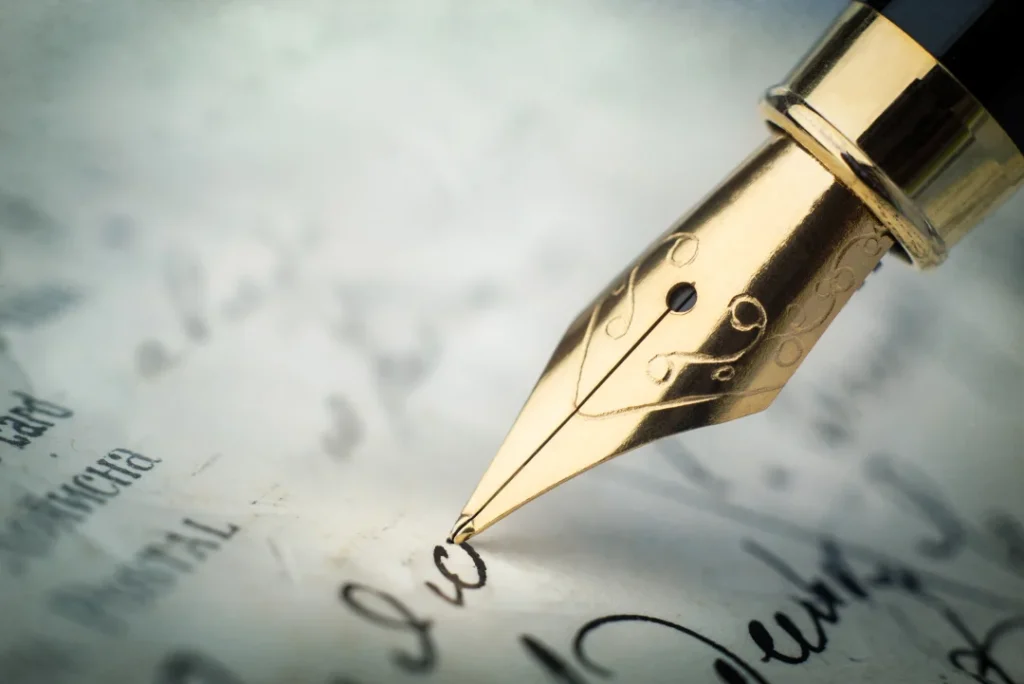
Underneath the ritual is genuine mechanical reasoning. A fountain pen delivers ink through capillary action, the same physical principle that pulls water up through a paper towel. Ink travels from a reservoir through a feed, a small grooved channel that regulates flow so the nib receives exactly enough ink and no more. Too much and the line floods. Too little and it dries out mid-stroke. The feed’s job is to solve that balance continuously, adjusting to gravity, temperature, and how hard you’re pressing.
The nib itself is not a fixed tip so much as a small spring. Quality nibs flex slightly under pressure, splitting the tines apart just enough to let more ink through on a downstroke, which is why fountain pen handwriting can carry natural variation in line weight that a uniform ballpoint tip cannot replicate. Press harder and the line widens. Ease off and it thins. The pen is responding to your hand in real time, which means your handwriting with a fountain pen is never quite the same twice, and never quite identical to anyone else’s.
None of this is complicated to explain, but it is easy to overlook, because the pen looks simple sitting on a desk. The complexity is entirely in what it is doing while you’re not thinking about it, which is the opposite of how most tools earn admiration. Usually we notice the machine when it does something impressive. Here the machine is impressive precisely because it stays out of the way.
The Person Who Still Uses One
Consider someone who writes for a living, not creatively, but administratively: meeting notes, drafts, the ordinary paperwork of a job that has long since gone digital. They could type all of it. Most of their colleagues do. But they keep a fountain pen in a drawer and reach for it specifically when something needs to be thought through rather than recorded.
The reasoning, when you ask people like this, tends to be less about romance than about pace. Typing keeps up with thought, which sounds like an advantage until you notice what it removes: the small delay that lets an idea finish forming before it’s committed. A fountain pen cannot keep up. It forces the hand to move at the speed of a considered sentence rather than a reactive one. Several people who’ve made this switch describe the same odd result: they remember what they wrote by hand far better than what they typed, not because handwriting is inherently more memorable, but because the slower pace gave the thought somewhere to land before it moved on.
“A fountain pen doesn’t care how fast you’re thinking. It only cares how steady your hand is.”
This is not an argument that everyone should abandon keyboards. It’s a narrower observation: some tools are built to match your speed, and some are built to set their own, and there is a category of thinking that only shows up when the tool insists on the second kind.
Why Friction Became a Value
Fountain pens are not the only place this pattern shows up. Mechanical watches persist in a world of phones that tell time more accurately for free. Manual transmissions persist in cars that shift faster and smoother without one. Film cameras persist alongside sensors that outperform them in every measurable way. In each case, the less convenient option has not survived because it’s better at the stated function. It has survived because a portion of its users decided the inconvenience was doing something the convenience couldn’t.
What that something is changes slightly by category, but the shape of the reasoning stays consistent. Convenience optimizes for the outcome and quietly discards everything that happened on the way to it. A photo taken and adjusted in seconds gets you the image; it does not get you the eighteen frames of a roll you had to be deliberate about because you couldn’t afford to waste any. A pen that requires you to slow down doesn’t just produce different handwriting. It produces a different relationship to the act of writing itself, one where the friction is doing quiet work the ease never could.
This is not an argument against convenience generally. Most of it is a genuine improvement and nobody sensible is asking for typewriters back in newsrooms. It’s a narrower claim: that a small number of deliberately difficult tools survive because difficulty was never the cost. It was the product.
What Gets Lost When Everything Is Easy
There’s a version of this piece that ends with a plea to slow down, to buy the pen, to reclaim some lost art of penmanship. That’s not quite what’s here. The pen itself is a small object and nobody’s life improves meaningfully because of what’s in their hand while they write a grocery list.
What’s worth sitting with is smaller and harder to argue with directly. Every convenience removes a small tax on effort, and most of those taxes deserved to go. But some of them were doing something on the way out the door that nobody accounted for. The wait for ink to settle was never just an inconvenience. It was a small, repeated reminder that the thing you’re about to commit to paper deserves a beat of consideration first. Remove the friction entirely and you don’t just save time. You lose the one part of the process that was asking you to mean it.
The people who still reach for a pen that costs more than it should are not choosing difficulty for its own sake. They’re choosing to keep one part of their day that refuses to be rushed, in a world that otherwise never asks.
The Paddock | Vitesse