The Word That Got Away From Us
There’s a version of the word “hybrid” that belongs to a certain kind of parking lot conversation — fuel economy, range anxiety, the quiet hum of a motor doing the work a gas engine used to do. That version of the word has been around long enough now that it’s hard to hear it any other way. It arrived with the Prius and it never really left, and somewhere in the process it attached itself to an idea: that hybrid means less. Less noise, less drama, less demand on the driver.
Formula One kept using the word anyway. It applies, technically. The current power units recover energy from sources that would otherwise be wasted and redeploy it as propulsion, which is exactly what a hybrid system does. But that’s where the resemblance ends, and the gap between those two applications of the same word is wider than most people realize. Not because F1 engineers are precious about terminology, but because what the hardware is actually doing at racing speeds has almost nothing in common with what a commuter car battery pack does on a Tuesday morning.
The confusion isn’t trivial. It shapes how people understand what F1 is actually building, what the technology costs, and what it’s capable of. It also obscures something genuinely interesting about where the limits of hybrid engineering currently sit, because they’re sitting somewhere most road car manufacturers haven’t come close to yet.
“The gap between those two applications of the same word is wider than most people realize.”
Two Units, One Job
The current F1 hybrid formula runs two motor generator units alongside the internal combustion engine. The MGU-K sits at the rear axle. The MGU-H connects to the turbocharger shaft. They’re related systems, but they operate differently, at different moments in the lap, for different purposes.
The MGU-K is the unit most people have a loose understanding of. Under braking, it acts as a generator, converting the kinetic energy of a decelerating car into electrical energy and storing it in a battery pack. Under acceleration, it inverts that process, deploying stored electricity as additional power at the rear wheels. The peak output is 120 kilowatts, which is roughly 161 horsepower added instantaneously, on demand. Road car hybrid systems work on a similar principle. The execution is different at racing speeds because the braking events are more violent, the energy transfer is faster, and the deployment has to be managed with enough precision that it doesn’t upset the car’s balance on corner exit. But the basic concept isn’t foreign.
The MGU-H is where the concept becomes something else. It connects directly to the turbocharger shaft and runs in both directions simultaneously with the MGU-K, but its job is thermal energy recovery, not kinetic. As exhaust gas spins the turbo, some of that energy goes through the MGU-H and into the battery. At other points in the lap, the MGU-H uses stored electrical energy to spin the turbocharger faster than exhaust pressure alone would drive it, reducing the lag between the driver pressing the throttle and the turbo reaching full boost. The result is a turbocharged engine that responds with something close to the immediacy of a naturally aspirated one, because the electrical system is filling the gap the exhaust can’t.
That’s not a feature. That’s a fundamental rethinking of how a turbocharged engine can behave. No road car does this. A handful of prototype systems have been demonstrated. None are in production.
“A turbocharged engine that responds with something close to the immediacy of a naturally aspirated one.”
What the Driver Actually Feels
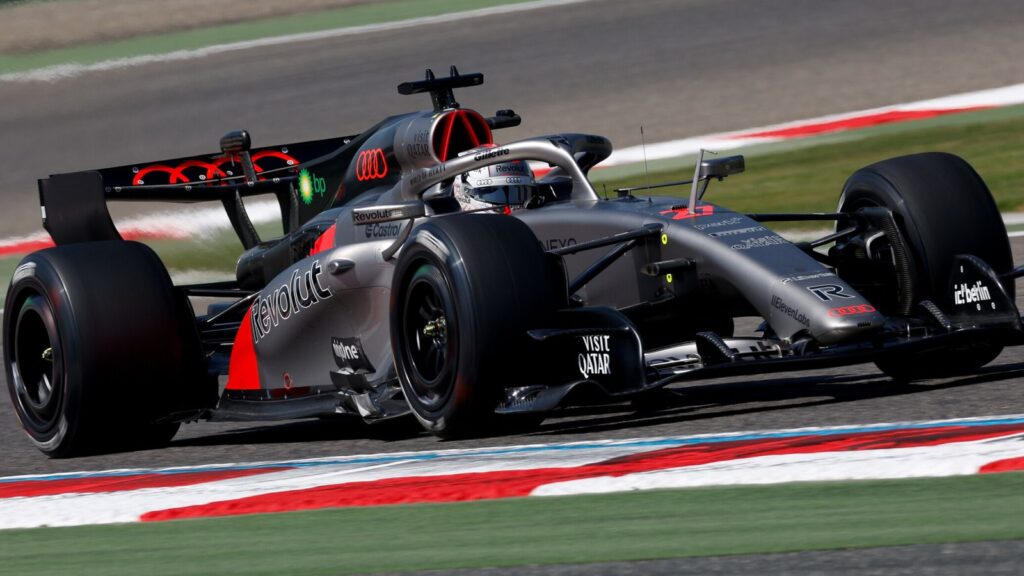
Energy recovery isn’t invisible from the cockpit. The MGU-K changes what happens under braking in a way that drivers have to manage actively. As the unit begins harvesting energy, it introduces a drag force at the rear axle that compounds with the mechanical braking force. Too much regeneration too early, and the rear steps out. Too little, and the battery doesn’t have what it needs for the next deployment. The deployment strategy is set by the engineers and written into the car’s software, but the driver still feels the difference between a car that’s harvesting aggressively and one that isn’t, and they adjust their braking point accordingly.
On corner exit, the MGU-K deployment defines the texture of the acceleration. The power arrives differently than it does from the combustion engine alone. It’s immediate, without the build that characterizes engine torque at lower revs, and that immediacy changes the way the rear tires load up. Getting out of a slow corner with the MGU-K deploying at full output is an exercise in managing a sudden and very large force at the rear wheels, through a steering angle that hasn’t fully unwound yet. The drivers who do it well tend to describe the sensation in terms of feel rather than mechanics, because it happens fast enough that conscious adjustment isn’t really part of it.
What the MGU-H eliminates, from the driver’s perspective, is the dead zone. In previous turbocharged F1 cars, the gap between lifting and reapplying the throttle was a genuine handling variable. The boost dropped, the power came back in a rush, and the rear behaved accordingly. The MGU-H doesn’t eliminate turbo lag entirely, but it compresses it to the point where the engine’s response characteristics stop being a significant factor in how the car behaves mid-corner. That’s not a comfort feature. It’s a performance gain that shows up in lap times partly because it allows the driver to be more precise with the throttle in situations where imprecision used to be unavoidable.

The Weight You Can’t Ignore
The hybrid system adds around 150 kilograms to the power unit. That number doesn’t sit in isolation. It sits on top of a minimum weight regulation that F1 has had to revise upward multiple times since the hybrid formula began in 2014, partly because the hardware kept coming in heavier than the initial estimates. Weight is always a trade-off in a racing car. Every kilogram is mass that has to be accelerated, decelerated, and carried through corners, and it places load on the tires, which affects wear, which affects pit stop strategy, which affects race outcome.
The hybrid system earns its weight because the performance gain it delivers is larger than what the weight costs. But that relationship only holds because the deployment is managed with extraordinary precision. The power is delivered at exactly the moments when the car can use it without overloading the tires or destabilizing the balance. The battery isn’t simply full and then empty in some predictable cycle. The engineers are managing a continuous flow of energy in and out of the system, corner by corner, lap by lap, in response to what the car is doing and what the strategy requires.
That level of energy management is what separates the current F1 formula from most hybrid road car systems, where the control logic is relatively simple because the operating environment doesn’t demand anything more. The performance gap between teams in F1 isn’t just about raw output. It’s substantially about who can manage that energy cycle most intelligently across an entire race distance.
“The performance gain it delivers is larger than what the weight costs — but that relationship only holds because the deployment is managed with extraordinary precision.”
Why This Matters Beyond the Track
F1 engineers are careful about claims that their technology transfers directly to road cars. Some of it does. A lot of it doesn’t, for reasons that have more to do with cost and production feasibility than with engineering limitations. The MGU-H is a good example of a system that demonstrates something important even if it never appears in a production vehicle.
The thermal efficiency of the current F1 power units is around 50 percent, meaning half of the energy in the fuel actually reaches the wheels as propulsion. Most internal combustion road car engines operate somewhere between 25 and 40 percent efficiency, and the better numbers in that range require significant engineering investment. The F1 figure is achieved partly through the combustion engineering itself and partly through the MGU-H recovering energy from the exhaust stream that would otherwise leave through the tailpipe as heat. That recovery doesn’t just add power. It raises the overall efficiency of the system by reducing what gets wasted.
Road car manufacturers are working on 48-volt mild hybrid systems that offer a modest efficiency improvement and some additional torque at low speeds. They’re working on full hybrid systems that offer larger gains at the cost of battery weight and complexity. None of them are working on exhaust energy recovery through a turbocharger-integrated motor generator at anything close to the scale F1 is operating at, because the cost and complexity don’t make sense at production volumes. What F1 has demonstrated is that the approach works, that the efficiency gains are real, and that the engineering challenges of managing two motor generator units alongside a turbocharged internal combustion engine at sustained high output are solvable. Those are not small things to demonstrate.
The broader electrification conversation tends to treat hybrid technology as a transitional phase, something between the combustion era and a fully electric future. That framing may be accurate for the automotive mainstream. At the performance edge, where the question isn’t range or efficiency per se but maximum output from a given fuel load under racing conditions, the hybrid formula looks less like a transition and more like a destination that took several decades to reach. Whether road car engineering ever gets there in meaningful volume is a separate question. The technology exists. F1 proved it works. What comes next depends on economics, not engineering.