





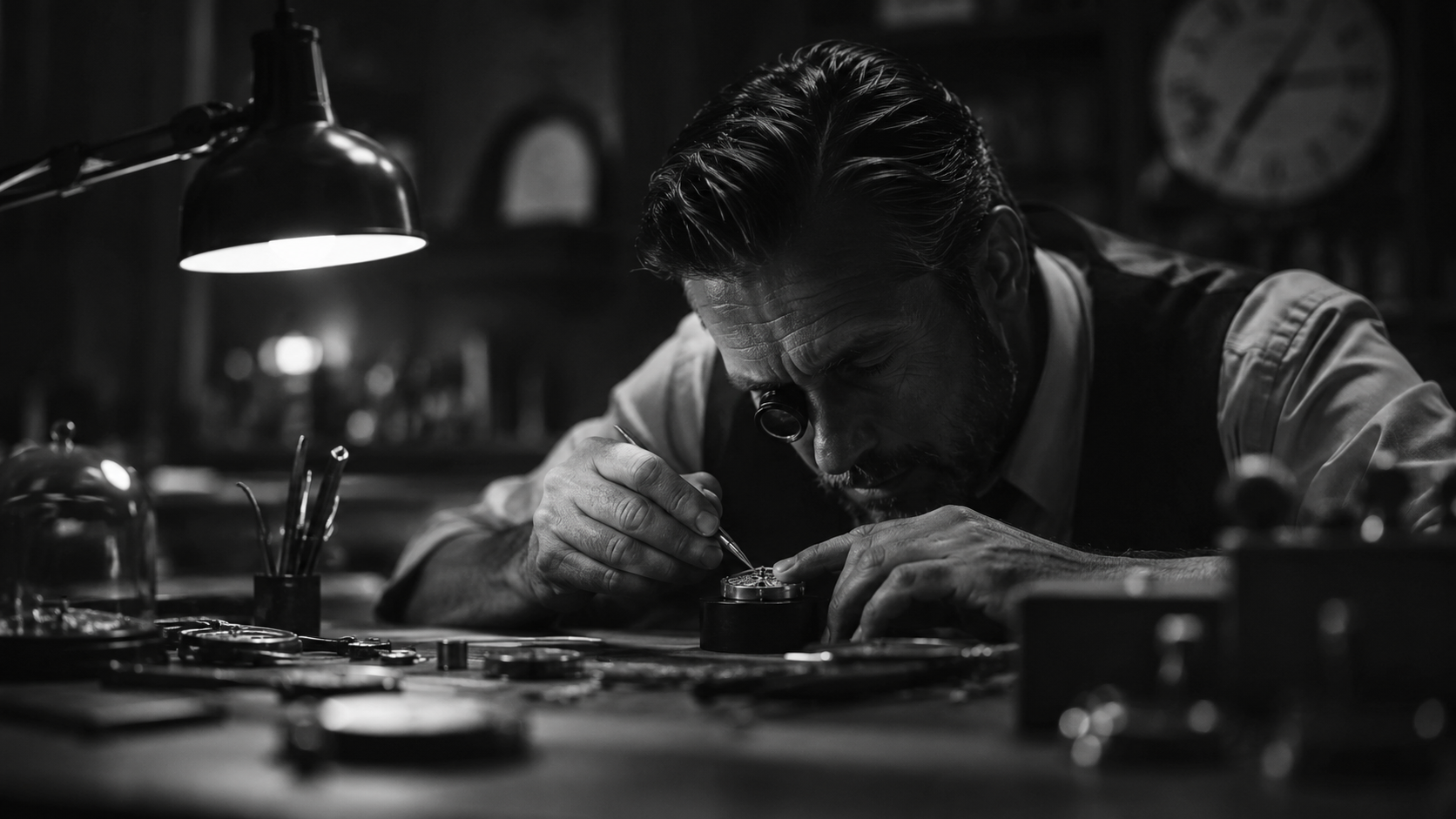
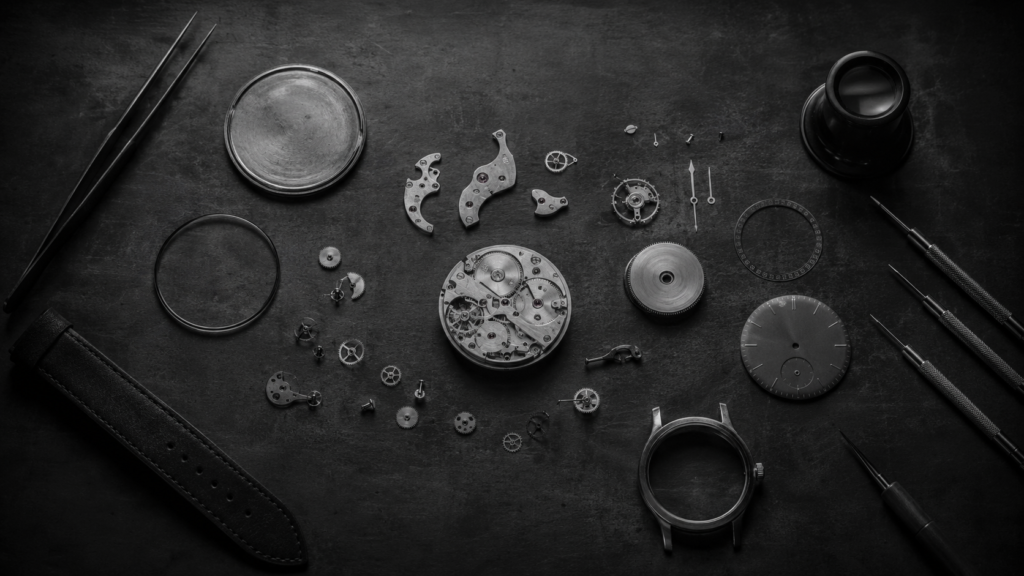
The bench is small, lit by a single articulated lamp, and everything on it costs more attention than money. A loupe. A staking set worn smooth at the handles. And, at the center, a movement no larger than a coin, taken apart into forty-odd pieces laid out in the order they came off, because putting them back in the wrong order is its own kind of disaster.
The watch belongs to someone’s grandfather, or someone’s father, or someone who bought it at auction because it meant something to them that it doesn’t mean to anyone else. It stopped running eight months ago. The part that failed is a small steel lever that controls how the mainspring releases its energy into the rest of the movement, and it sheared, the way metal fatigues after enough decades of doing the same small motion.
There is no replacement. The manufacturer that made this watch stopped producing that specific caliber before most of the tools in this workshop were built. No supplier carries the part. No catalog lists it. The factory that could once have shipped a new one in a padded envelope closed its doors, or was absorbed into a larger company, or simply stopped making anything this small and this particular a long time ago.
So the lever gets made. By hand, on a lathe that predates the internet, to a tolerance measured in microns.
The Part That Doesn’t Exist
This is the part of the job that doesn’t show up in most descriptions of watchmaking. People imagine cleaning, oiling, adjusting a screw here or there. They don’t imagine a craftsman staring at an empty space in a movement where a part should be, and understanding that the only way forward is to become, briefly, the manufacturer that no longer exists.
The watchmaker picks up a scrap of steel roughly the right dimensions and turns it over under the lamp. He has done this before, more times than he counts, and the routine has never once become simple. Every failed part is its own small negotiation between what the original engineer intended and what fifty years of wear has left behind as evidence.
There’s no factory to call. There’s just the part in front of him and the one he has to make.
Reading a Dead Company’s Intentions
Before a single cut gets made, there’s a longer process that has nothing to do with metal. It’s reading. The watchmaker studies the parts still attached to the movement, the ones surrounding the gap where the lever used to be, because they carry the imprint of what fit there. A pivot hole worn slightly oval tells him which direction force was applied and how much. A witness mark on a neighboring bridge tells him the exact angle the lever traveled before it stopped.
None of this is written down anywhere. The company that built this movement kept technical drawings once, and some of those drawings survive in private collections or industry archives, scattered and incomplete. More often, there’s nothing. The watchmaker has to reconstruct not just a shape but an intention, understanding what a specific engineer, working at a specific bench decades ago, was trying to accomplish with a piece of steel a few millimeters long.
It’s a strange kind of intimacy, spending an afternoon trying to think like someone who has been dead for thirty years, using only the evidence their work left behind. He measures, adjusts his sketch, measures again. The margin for error is almost nonexistent. A lever cut a few microns too thick will bind. Too thin, and it will fail again within a year, and this whole process starts over.
The Tolerance Test
The lathe spins. Steel comes away in curls too fine to see individually, just a haze catching the light. He checks the part against calipers, against the sketch, against his own memory of how the worn original must have looked before it failed. This step happens slowly and it happens more than once. The first attempt doesn’t fit. Neither does the second.
There’s no frustration in this, or if there is, it doesn’t show. This is what the work actually is, not a single clean motion of craftsmanship but a repeated cycle of cutting, testing, and rejecting, until a piece of metal that didn’t exist an hour ago slides into a decades-old movement as though it had always belonged there.
When it finally seats correctly, there’s no ceremony. He sets the bridge back over it, checks the action with a light touch of a tool, and moves to the next piece in the sequence of reassembly. The part that took an afternoon to make will likely never be seen again, sealed inside a case, doing its job in silence for another fifty years if he got it right.
He isn’t restoring the watch. He’s finishing an argument the original engineer never got to have.
What Skill Costs to Keep Alive
There are not many people who can do this. The number shrinks every year, not dramatically, just steadily, the way any skill shrinks when it takes a decade to learn and offers no shortcut. Watchmaking schools teach the fundamentals, but this specific ability, fabricating obsolete parts from evidence rather than drawings, gets learned mostly through years at a bench, usually under someone else who learned it the same way.
It isn’t romantic, exactly, or it doesn’t feel that way from inside the workshop. It’s a small number of working hours in a year, applied to objects that most of the world has stopped thinking of as repairable. A phone gets replaced. A watch, if it’s the right watch and it lands in front of the right person, gets rebuilt from the inside out instead.
The tolerance the original factory would recognize as correct is the only standard that matters here.
This is a strange kind of responsibility to carry, being one of a shrinking number of people who can keep a specific category of object functioning at all. Not for profit, particularly, since this work doesn’t scale and was never going to make anyone wealthy. It continues because someone has to be willing to sit with a problem that has no manual, and solve it anyway, correctly, for an audience of no one who will ever know how hard the part was to make.
The Watch Keeps Time Anyway
By the end of the day, the movement is reassembled, the case closed, the watch wound and set against the workshop clock. It runs. There’s no fanfare in this either, just a quiet second hand sweeping around a dial that has been silent for the better part of a year, doing exactly what it was built to do a lifetime ago, because someone was willing to think like the person who built it and finish the job by hand.
It will go back to its owner without a story attached, most likely. A ticket, a receipt, an explanation limited to what needed fixing. The hours spent reconstructing a dead manufacturer’s intentions from wear patterns and a fifty-year-old sketch will stay inside the workshop, invisible in the object itself, the way most real craftsmanship is.
The Paddock | Vitesse