


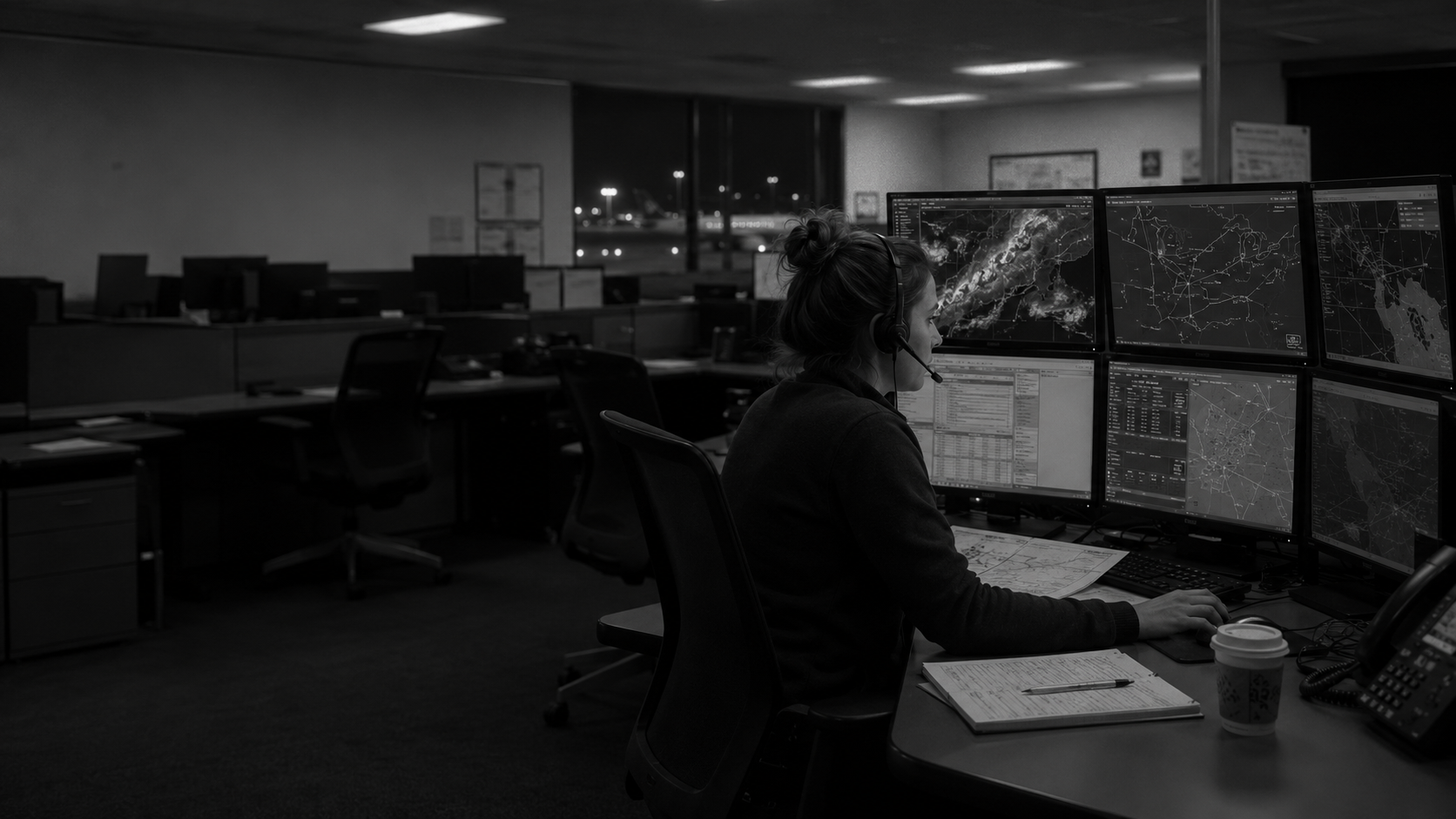
The operations center doesn’t look like anything from a movie. No wall of red lights, no countdown clock, no room built for drama. It’s fluorescent and quiet, rows of desks facing banks of monitors that track weather cells, airspace restrictions, and the slow crawl of a dozen airplanes across a map of the country. Somewhere past midnight, a dispatcher sits at one of those desks with a headset on and a stack of releases building in a queue, and nobody boarding any of those flights will ever know her name.
Every flight that leaves the ground carries a document called a release. It has to be signed twice. Once by the captain, who everyone assumes holds final authority over whether a plane flies. Once by the dispatcher, whose signature carries the same legal weight. Federal regulations don’t treat this as a formality or a rubber stamp. The captain and the dispatcher share joint authority over the decision to fly, and either one can refuse to sign. Passengers walk past the cockpit door and assume the person inside made every call alone. They have no reason to think otherwise. The system was built so they wouldn’t have to.
What the Fuel Number Actually Means
A release isn’t a single decision. It’s a stack of them, compressed into numbers that look like arithmetic but aren’t. The fuel load on a flight from Denver to Chicago has to account for the trip itself, then for holding time if the airport’s running slow, then for a legal alternate in case Chicago closes entirely, then for a reserve beyond that. Each of those numbers depends on weather that hasn’t happened yet, on how a specific aircraft burns fuel at a specific weight, on whether a deferred maintenance item is quietly costing the plane efficiency it doesn’t have to spare.
Weight and balance work the same way, layered underneath. Cargo, passenger count, bag weight estimates, all of it shifts the aircraft’s center of gravity, and the dispatcher has to know where that center sits before anyone boards. None of this shows up to the passenger as a decision. It shows up as a number on a screen that either clears the flight or holds it. The work is invisible by design. That’s what makes it work at all. <blockquote>Every number on the release is a judgment wearing the disguise of a calculation.</blockquote>
The Reroute
At 9:40 on a Tuesday night, a line of convective weather starts building faster than the forecast called for, right across the corridor a flight to Newark was supposed to fly. The airplane is fueled, boarded, thirty minutes from pushback. The captain calls down to operations, because that’s protocol when the picture on the ground doesn’t match the picture the crew is looking at from the gate.
The dispatcher pulls up the radar loop, cross references it against three other model runs, and watches the cell’s edge shift eleven miles in four minutes. There isn’t a clean answer sitting in the data. There’s a route that adds forty minutes and burns fuel the current load doesn’t fully cover unless the alternate changes too, and there’s holding at the gate until the picture clarifies, which might cost the crew their duty day. Somebody has to close the gap between what the models show and what has to happen in the next ten minutes.
She recalculates the fuel against the longer routing, checks it against the new alternate, and calls it. The captain agrees, because the captain has no better information than she does and knows it. The reroute goes into the release. The flight pushes twenty minutes late. Nobody in seat 14C ever hears any part of this conversation happened. They just feel the extra time in the air and assume it was weather, which it was, without knowing that a stranger they’ll never meet did the math that got them through it.
Twelve Flights, One Person
The Newark decision was one flight. At the same desk, at the same hour, eleven others are moving across the board, each at a different stage. One is still building its release two hours from departure. One is airborne over Nebraska, its fuel burn tracking slightly high, worth watching but not yet worth acting on. One diverted an hour ago and is sitting on the ground in Omaha waiting on a new plan. The dispatcher isn’t working one problem at a time. She’s holding all twelve at once, in varying states of resolution, and the attention required to do that doesn’t look like anything from outside. It looks like someone typing, glancing between screens, occasionally picking up a phone.
The job’s success gets measured by what doesn’t happen. No fuel emergency. No missed weather call. No release signed on bad math. There’s no applause built into that kind of outcome, no moment where the absence of disaster gets pointed at and credited. A pilot lands a difficult approach and passengers sometimes notice the skill in it. A dispatcher gets a flight through six hours of shifting weather and nobody on board experiences anything except an unremarkable trip, which was the entire point.
The Signature Nobody Reads
By the time the Newark flight reaches cruise, the release is filed, the shift has moved on to the next set of decisions, and the paperwork sits in a system that almost nobody outside the industry will ever open. It exists as a record of authority exercised, math checked against reality, a name attached to a decision that shaped a flight full of people who will never know it was made.
There’s something in that arrangement worth sitting with. A stranger’s judgment, applied carefully, absorbed entirely by people who never asked for it and never see it. Responsibility carried to completion with no witness and no acknowledgment, discharged the same way whether anyone notices or not. The dispatcher doesn’t do the job differently depending on who’s watching, because nobody ever is. The work only means something if it gets done right regardless.
Somewhere over Ohio, the Newark flight starts its descent on schedule. The captain flies the approach. The passengers gather their bags. None of them will ever read the signature that got them there, and none of them need to. That was always the arrangement. Somebody else carried the weight so they wouldn’t have to feel it.
The Hangar | Vitesse