The pit lane is largely defined by noise and constant motion, but the painted rectangle outside the garage is governed by a peculiar kind of waiting. For most of the race, this box sits completely empty under the glaring sun or harsh floodlights, a vacant stage marked by bright tape and thick rubber streaks left behind by previous stops. Inside the garage, mechanics monitor telemetry screens and listen to radio chatter. They are relaxed but attentive, watching data streams that translate a driver’s physical struggle into numbers. Then the race engineer makes the call. The shift in the garage is immediate. The relaxed posture vanishes, replaced by a sudden, purposeful surge toward the open air.
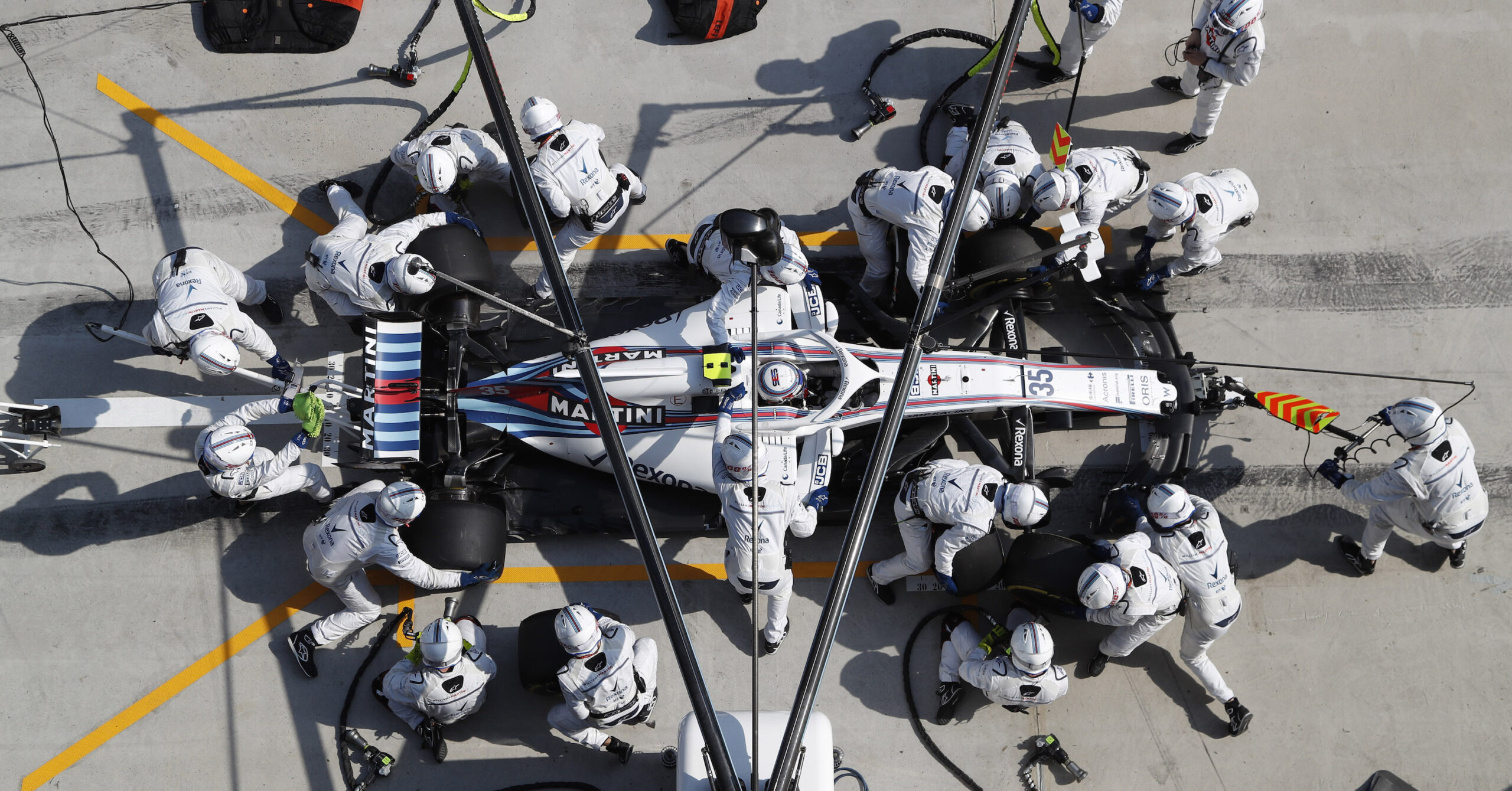
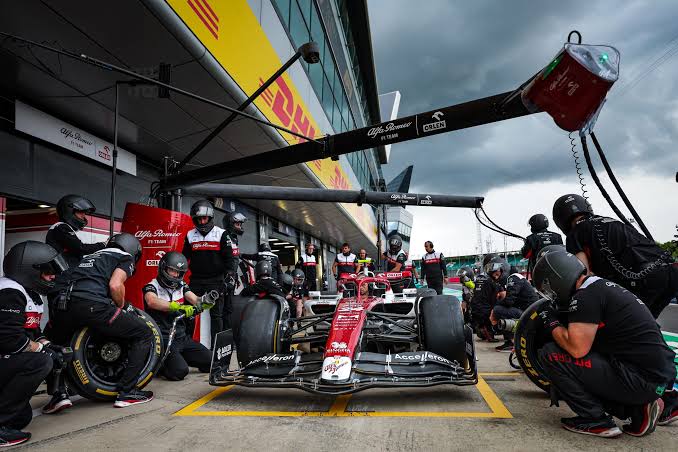
Walking out to the box is a well-rehearsed ritual. Twenty people step over the line and arrange themselves around a void. They carry heavy equipment and fresh tires wrapped tightly in electric heating blankets. For a few seconds, the formation is surprisingly loose. A mechanic might adjust the visor on his fireproof helmet or tap a heavy slick against the concrete to ensure it sits perfectly on the rim. The car is still miles away, navigating the final sector. The crew settles into their designated spots. As the engine note grows louder in the distance, bouncing off the grandstands, the mechanics sink into a low crouch. They shift their weight forward to the balls of their feet. The air in the box seems to compress and thicken. The crew is no longer just waiting for a car to arrive. They are coiled and braced for a controlled impact.
Erasing the Individual
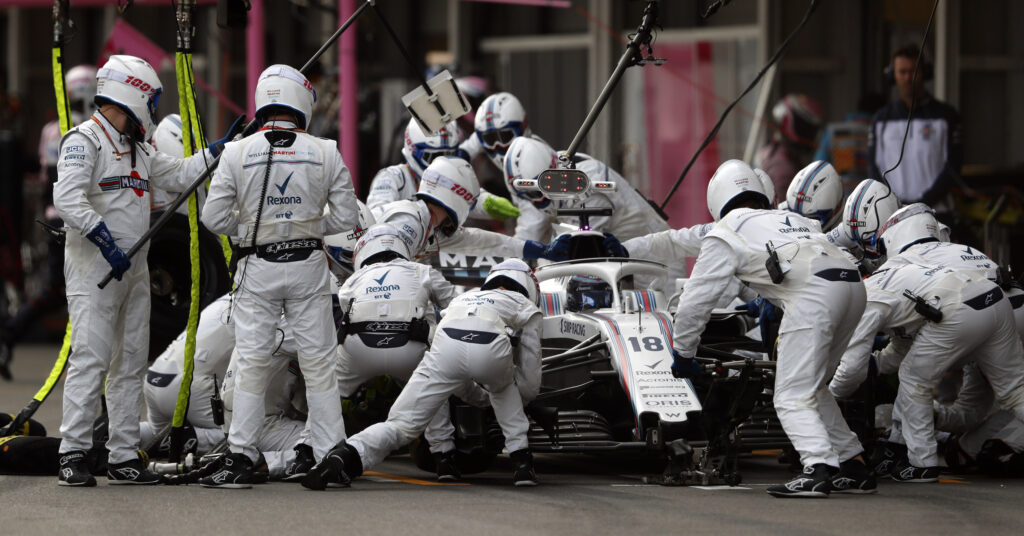
A competitive pit stop leaves absolutely no room for personality or ego. To execute a two-second tire change, the people involved must abandon their autonomy and operate as highly specialized extensions of a single nervous system. There is no star player in a pit crew. If one person tries to work faster than the collective rhythm, the entire sequence collapses. The goal isn’t individual speed, but absolute synchronization.
The mechanic holding the wheel gun doesn’t look to see if the rim is clear before pulling the trigger. The person assigned to pull the old tire away reacts the instant they hear the pneumatic whine of the gun spinning backward. The replacement rubber is thrust forward without anyone waiting for a visual cue to confirm the space is empty. Every motion depends completely on the assumption that the person standing inches away will not fail. It is an exercise in profound blind faith.
“If the crew trusts in their performance and follows the processes laid out, the fast and consistent stops will come.” — McLaren Pit Crew Development
These individuals spend hundreds of hours in the factory practicing this exact sequence until muscle memory takes over. They learn the exact weight of a tire, the precise angle of the suspension spindle, and the specific metallic clack of a securely fastened wheel nut. Mercedes’ Chief Mechanic Matt Deane has described the process as beginning in the first week of January, crews rotating through multiple roles so that every mechanic can step into a different position and perform at a high level. The majority of the crew are trained in at least two functions. By the time race day arrives, the individual mechanic disappears into the mechanics of the stop itself.
The structure of the crew reflects this philosophy. Twelve of the twenty-plus members are entirely dedicated to the tire change process, three working each corner. One loosens and tightens the wheel nut with a pneumatic gun. Another pulls the old tire. A third pushes on the new one. Two jack operators lift the car at the front and rear, each needing to generate enough force to raise a machine running extremely low on its suspension with ground-effect aerodynamics pressing it toward the ground. The rear of the car rises roughly 0.4 seconds into the stop and drops again at 2.1 seconds. That window is the entire margin for error at the back corners.
Violence and Precision
The act presents a jarring paradox between raw force and delicate calibration. A modern racing car arrives in the box violently. It drops from highway speeds to a dead stop in a matter of feet. The arrival brings a literal wave of radiant heat, the sharp scent of burnt carbon brakes, and the overwhelming noise of an engine idling just off the rev limiter. The mechanic operating the front jack stands directly in the path of this incoming machine, trusting the driver to hit their marks with absolute perfection. A lock-up or a missed braking point by just a few inches means someone is going to the hospital.
The tools required to service the car are equally brutal. Wheel guns are heavy blocks of dense metal that kick hard enough to shatter a wrist if held incorrectly. The jacks must lever a massive weight of composite material into the air with one aggressive downward thrust. Yet the mechanics must handle this violence with surgical exactness. A wheel nut needs to thread flawlessly onto a glowing hot spindle in a fraction of a second. If a new tire is angled even slightly upon entry, it will jam and ruin the stop. The crew applies massive physical force, but they do it with millimeter accuracy, completely ignoring the exhaust pipe roaring uncomfortably close to their knees.
The current world record stands at 1.80 seconds, set by McLaren at the 2023 Qatar Grand Prix. Since Guinness World Records began monitoring the fastest F1 pit stop in 2013, only 0.12 seconds have been shaved from that record over more than a decade.
There is an FIA regulation buried inside this chaos that captures how precise the choreography has to be. Mechanics must take at least 0.15 seconds during the tire change to ensure the wheels are properly tightened, and the driver must wait an additional 0.2 seconds before leaving. Those fractions of a second are legally mandated minimums against catastrophe. They exist because the violence of the stop creates the conditions for it.
Front and rear operations aren’t even identical. Rear wheels are larger and heavier, requiring more strength and leverage to maneuver. The dished wheels with recessed nuts at the back mean those gunners have to wait until the car is completely stationary before engaging, while front wheel gunners can begin positioning onto the wheel before the car fully stops. The distinction sounds minor. At 1.80 seconds total, it’s the difference between a functioning stop and a fumbled one.
The Mathematics of Half a Second
When discussing pit stop performance, the conversation always circles back to time. Not in any broad sense, but in increments that most humans can’t consciously perceive. A stop under 2.0 seconds can gain two positions on track. A stop beyond 2.5 seconds is now considered long. The fastest pit stops in the 2024 season were measured at 1.90 seconds, achieved by Red Bull at the Chinese Grand Prix and matched by McLaren in Mexico City.
Red Bull have built a dynasty around this particular skill. Their seventh consecutive DHL Fastest Pit Stop Award came at the end of 2024, a streak stretching back to 2022 and built on consistency rather than any single heroic stop. Seven of the ten fastest pit stops during the 2024 season were theirs. The award isn’t given to the team with the single quickest stop of the year but to the team that accumulates the most points across every race, 25 for first, descending to one for tenth. Consistent excellence across a 24-race calendar is what wins it.
In 2025, Ferrari broke that Red Bull dominance to claim the DHL Fastest Pit Stop Award, ending a run that had seemed almost structural to how the sport operated.
The mathematics of what these times represent is worth sitting with. McLaren’s 1.80-second record at Qatar in 2023 involved more than twenty people performing their individual tasks in a window roughly equivalent to the time it takes to blink twice. The record had sat at 1.92 seconds from 2016 until 2019, when Red Bull broke it three times in a single season. In 2023, McLaren pushed it to 1.80. Since then, despite enormous effort across every team in the paddock, nobody has broken it. Statistical modeling of the 2025 season placed the probability of seeing a new world record at around 20 percent heading into the final stretch of the year. A one-in-five chance, after decades of refinement, is how close the sport is to the apparent ceiling.
The Weight of the Release
The routine concludes just as abruptly as it starts. Once the four wheels are secure, the gun men raise their hands in unison. The jacks fall away. The driver drops the clutch, and the car launches back into the fast lane. The crew is left standing in a haze of tire smoke and a sudden, disorienting quiet as the engine note fades down the track.
The human machinery instantly unwinds. Mechanics straighten their backs and pull off their helmets to wipe the sweat from their faces. The massive adrenaline spike peaks and quickly recedes. In less than three seconds, they have either secured a strategic advantage or compromised an entire weekend of preparation. The weight of that reality hits them the moment the car leaves the box.
The 2024 Abu Dhabi finale illustrated exactly what that weight means. On lap 25, Carlos Sainz pitted in an attempt to undercut Lando Norris. Norris responded on the following lap. McLaren hadn’t been constructors’ champions since 1998. Everything in that moment fell to the pit crew. Norris hit his marks. The crew serviced the car in 2.07 seconds. He hammered out of the pit lane and retained the lead, won the race, and secured the title. The stop took 2.07 seconds. The championship had been building for an entire season.
Norris hit his marks. The McLaren crew serviced the car in 2.07 seconds. He retained the lead, won the race, and secured the constructors’ championship.
Now their direct influence on the race is completely gone. They pick up the blistered tires, gather their heavy equipment, and retreat into the shadows of the garage. The transition is absolute. They fold away their tools and look up at the timing monitors overhead. The coiled unit dissolves, and they revert from the most critical participants in the race back into powerless spectators, hoping the machine they just touched holds together until the checkered flag.
The pit stop is the sport’s most compressed expression of how racing actually works. The television broadcast will follow the cars on track, the strategy calls from the pit wall, the telemetry conversations between driver and engineer. But the stop itself, those two seconds of controlled violence in a painted box, is where the gap between preparation and failure closes entirely. There is no simulation for race day pressure. There is only the work done in January, through winter darkness, on a factory floor in Milton Keynes or Maranello or Woking, with no crowd and no broadcast and no consequence except the trust that when the moment arrives, the hands will remember.